
In recent years, Toro has supplanted Robusto as the King of cigar sizes. In 2007, Cigar Aficionado deemed us in the Robusto generation. By 2020, Robusto accounted for just 24% of sales according to a Cigar Aficionado survey while Toro almost doubled that at 51.7%. In 2023, Toro made up for almost 70% of sales while Robusto lost ground at just above 13.5% of sales. With more people flocking to the value that Toro sizes have to offer, it begs the question: aside from the value proposition, what’s the real difference between a Robusto and Toro cigar?
Robusto and Toro Difference For Science
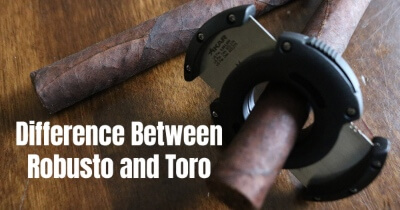
To answer this question literally, I used my cutter to chop an inch off of a Toro cigar that I am very familiar with. My hypothesis is that the reduction in length will make the flavors change slightly while increasing the body of the cigar. I expect this to happen because what we taste in a cigar boils down to the tobacco used, smoke concentration, airflow, and combustion. Much like punch-cutting a cigar versus using a straight cutter, changing the length has the possibility of changing the mechanics and impacting the flavor profile. I used the same two cigars out of the same box.
In my experiment today, both expressions of this cigar became noticeably different over time. In the first few puffs, the shorter size had slightly more punch to it with brighter tasting notes whereas the original Toro size was more balanced and well-rounded. But for the first 5-10 minutes, I’m not sure the average cigar enthusiast would appreciate the difference without looking for it. It was still subtle, and if I wasn’t smoking them side-by-side I probably wouldn’t notice it myself. Smoking them back to back may have made it much harder to discern.

Click the image above to read more about how cigar sizes matter
With about an inch of ash on both cigars, however, the difference was quite significant. The original Toro size developed into a complex expression of milk chocolate, espresso, roasted malt, and leather. The would-be Robusto took a different approach of baking spices, juniper, and what reminds me of dried apricot. One could have been a porter, the other could have been a gin. The smaller size was still sharper, with each tasting note having a very prominent moment of glory. In a blending room, I can imagine this size being tossed out for lacking balance.
I still wasn’t sure if the original Toro size would end up tasting like the Robusto at some point. Even though I have smoked more than a box of these in the past, I’ve never given it the amount of scrutiny that I am today. And a question still remained in my mind: did I just fast-forward the experience by chopping an inch off, or are these two unique expressions of the same cigar?
Past the midway point, I did start to taste juniper in the original Toro size. But it wasn’t bright or loud at all: the flavors harmonized with the aforementioned notes along with toasted almond, earth, and heavy cream. Conversely, the shorter size developed dark chocolate notes at the close – and the lack of harmony was quite delicious at this point, like a solo guitar riff.
Robusto and Toro Difference In Reality
Now, to answer this question comprehensively, we must talk about the Blender’s intent. Some brands blend each size separately. You may find that each size uses slightly different tobaccos to maintain the intended profile throughout the portfolio. Since not all Toros are just an inch longer than a Robusto, slight tweaks may be needed to go from a 5 x 50 to a 6 x 54 and keep the same intensity. Or, if the same ratio of tobaccos is kept in the larger ring gauge, the Toro may ‘hit different’ as the cool kids say. And none of this takes into account the distribution of breaks in the bunch for various lengths or partial leaves used in blends.
We always recommend trying multiple sizes of a cigar before landing on a favorite because there are so many behind-the-scenes factors that come into play. But I hope that this simple test encourages more of us to try different things and experiment at home.


Leave your comment